
Pulaski County Traffic Warrants Explained
A traffic case can lead to a warrant if a person fails to comply with a summons or misses a required court date, subject to limits in Virginia law. Not every unpaid ticket becomes a warrant. The court reviews the case and applicable rules, so the citation and docket must be checked before deciding what is owed or required.
Pulaski traffic cases appear in General District Court. The schedule names the Sheriff's Office, Pulaski Police, Dublin Police, and Virginia State Police for local traffic or criminal sessions. Keep the issuing officer or agency with the citation so the clerk can locate the correct case.
Pulaski County Traffic Cases Come From Several Agencies
The public General District Court schedule lists traffic and criminal sessions involving the County Sheriff's Office, Pulaski Police, Dublin Police, and Virginia State Police. Several agencies can send a citation to the same court, so the town or officer on the paper still matters. Keep the citation, court date, and any case number together.
A town ticket does not mean the town has a separate public warrant portal. The county GDC clerk is the practical contact for the case file. Ask the clerk which office handles a missed date or a later process entry.
Pulaski General District Court's official page lists its schedule and clerk contact.
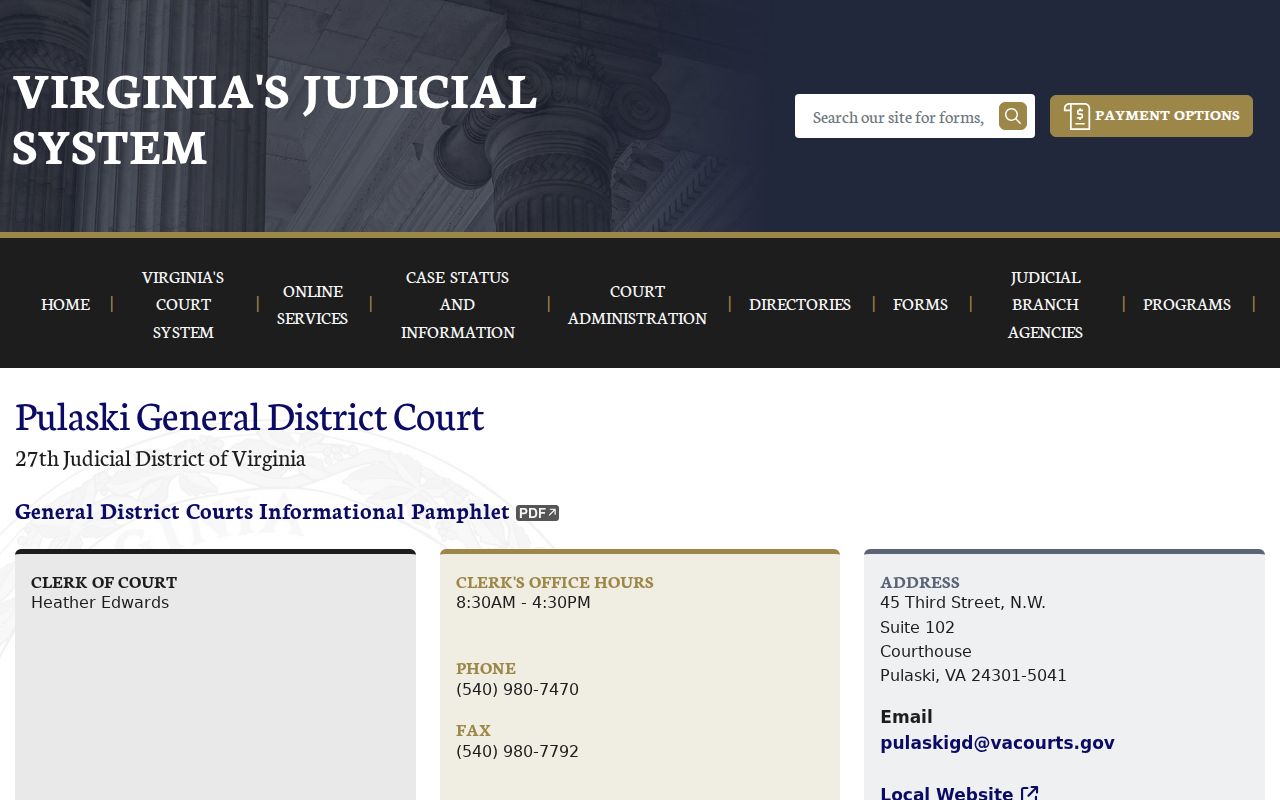
The schedule places town and state police traffic matters on the county court calendar.
Checking for a Traffic Warrant
Search the Pulaski General District Court case system by court, last name, case number, or hearing date. A traffic case number in the state help examples uses the GT family. The system displays case information, not a complete warrant-only roster, and it cannot take payment through the statewide search.
- Use the official GDC case search, choose Pulaski, and enter the case number or exact name.
- Check the hearing date and open the case details; current, archived, and all-data options are available.
- Call the General District Clerk if a missed date, FTA, or process entry appears.
- Call the Criminal Warrants Clerk for local execution routing, then ask counsel about the court's required action.
Pulaski County Traffic Warrant Search Fields
The GDC interface uses court, name, case number, hearing date, and data status controls. A traffic case number is useful when a name search is broad. The case-detail control opens the available docket information. A payment marker appears only for eligible prepayable offenses.
| Search field | Use | What to check |
|---|---|---|
| Court | Select Pulaski GDC | The system searches one court at a time. |
| Last name | Required for name search | Match the spelling on the citation; wildcard is supported. |
| Case number | Use if known | Traffic examples use the GT family. |
| Hearing date | Alternative search | Enter the date as MM/DD/YYYY. |
| Data status | Choose Current, Archived, or All | Archived records may help locate older history. |
The official GDC help page defines the search fields and controls.
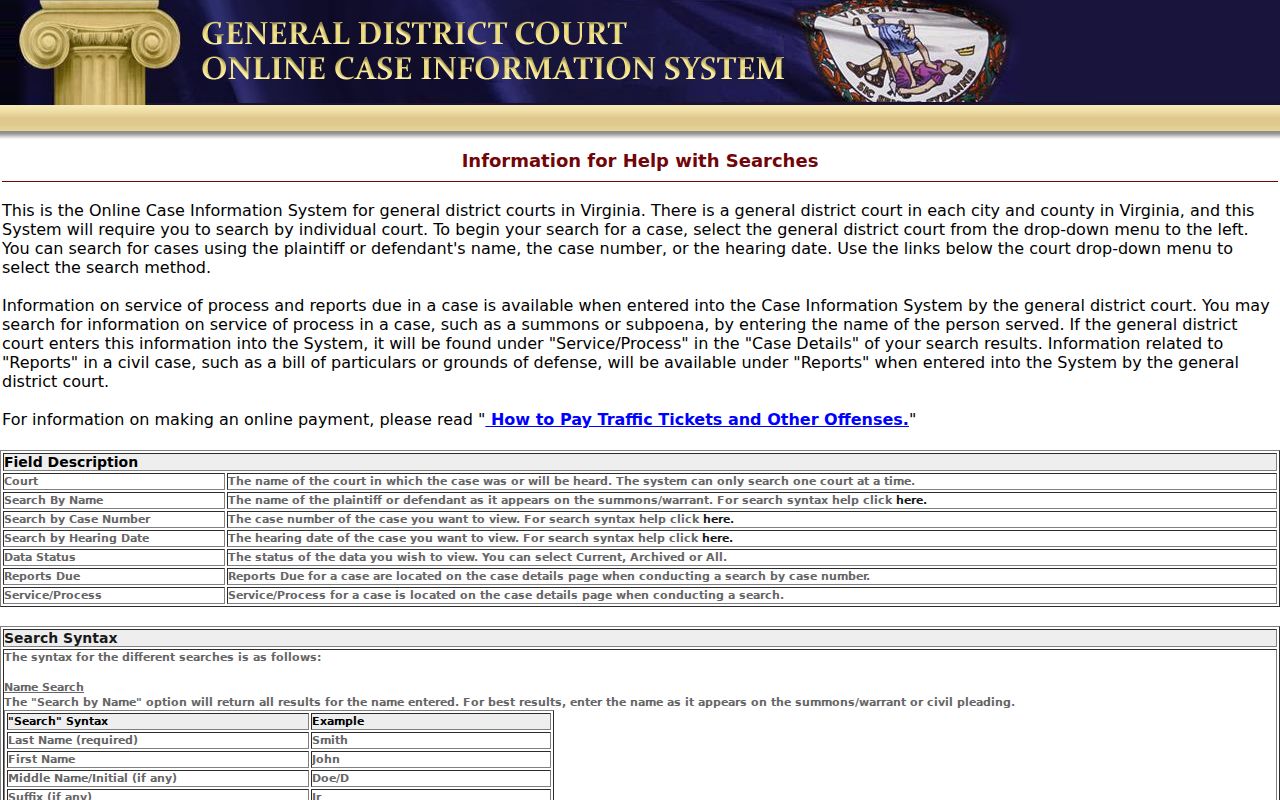
Use the case result as a pointer to the docket, then call the clerk about process.
Inside a Traffic Warrant Record
The public search is organized around the court case. It can show a case number, case type, party, hearing date, payment marker for eligible offenses, and case-detail controls. It may not identify the officer or explain whether a warrant has been issued. The clerk can read the docket with you.
| Case number | GT00000000-00 is a format example from the GDC help page, not a real case. |
|---|---|
| Charge or case type | Read it with the issuing agency and court date from the citation. |
| Issuing court | Pulaski General District Court for the local traffic docket. |
| Payment marker | Eligible prepayable offenses may show a Mark for Payment control. |
| Process status | Call the clerk to confirm any FTA, warrant, capias, or later court action. |
Pulaski County Warrant Payments Need Court Review
Virginia's pre-court ticket instructions say an eligible payment must reach the court before the trial date. A payment received after 3:30 p.m. is processed the next business day. Certain cases allow checks, money orders, certified checks, or credit cards, but a person should confirm the Pulaski court's current instructions before sending money.
If the date has passed or the case shows an FTA or warrant, stop and call the clerk. The ordinary prepay control is not a warrant recall. The clerk can say whether a continuance request, new date, judge hearing, or another step is required.
The Virginia court ticket page links to General District payment instructions and a lost-summons route.
How to Pay or Lift a Traffic Warrant
First ask the clerk whether the case can still be paid before court or whether a missed date has led to separate process. A normal ticket payment does not necessarily lift a warrant after the trial date. The clerk can tell you whether the court wants payment, a continuance request, a new appearance, a judge hearing, or a magistrate and bond step.
- Locate the Pulaski GDC case and confirm the charge, court date, and current process.
- Read the summons instructions and call the clerk before sending payment after a missed date.
- Ask whether the court needs a continuance, a new appearance, or a hearing before a judge or magistrate.
- After the court acts, ask when the docket or any compliance notice will reflect the change.
Warning: Do not assume an eligible ticket payment button recalls a warrant; call the clerk when the trial date has passed.
Pulaski County Warrant and License Rules
Virginia's traffic statute contains language about a failure to comply with a summons, but current law and DMV rules must be read together. The DMV says courts stopped suspending driving privileges only for unpaid fines and costs as of July 1, 2019. This did not erase the debt or prevent suspension for other legal grounds.
Ask the court what compliance notice applies to the case and check directly with DMV for license status. Do not infer a license hold from a warrant result or use the court case search as a driving record.
Virginia DMV's fines and costs page describes the rule change.
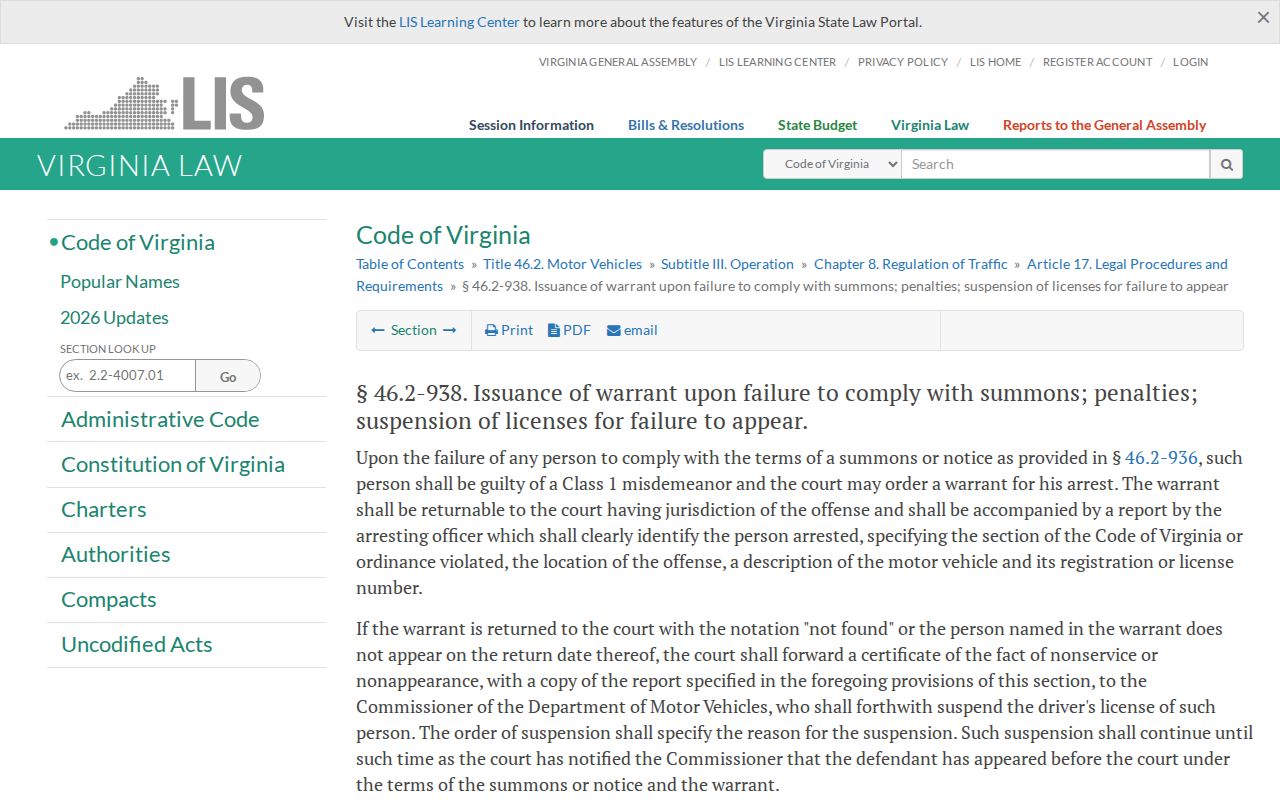
The statutory process and a license action are related questions, but they are not the same record.
Traffic Warrants, FTA, and License Holds
A warrant, an FTA entry, and a license action are related but distinct. Virginia Code section 46.2-938 addresses failure to comply with a summons. The Department of Motor Vehicles says courts stopped suspending driving privileges solely for unpaid court fines and costs on July 1, 2019. Other grounds for suspension remain. Ask the court what applies to the specific case.
| Mechanism | What Triggers It | What It Does |
|---|---|---|
| Traffic warrant | Failure to comply with a summons when allowed by law | Authorizes action under the court order |
| FTA | Missed required court setting | May lead to separate court process |
| License suspension | Another statutory or court-related ground | Ask DMV or court what rule applies; unpaid fines alone stopped being a suspension ground in 2019 |
Pulaski County Traffic Warrant Status Needs Clerk Review
The GT prefix in an example case number identifies a traffic case family, not the issuing officer and not proof that a warrant exists. A Pulaski County Sheriff's citation, a Pulaski or Dublin Police citation, and a State Police citation can point to the same court while retaining different agency details.
If a case result shows an old date or a payment, bring the receipt or citation number to the clerk. Ask whether the court has entered an FTA, warrant, capias, or a new appearance date. Confirm again after the court acts because online case information may not update at once.
The county warrants contact can route execution questions after the clerk identifies the case.